At the Nuremberg Trials, the Allied powers promised the world something unprecedented: that those responsible for the greatest crimes in human history would be held personally accountable, regardless of rank or title. It was a bold declaration that law would rise above power, and that moral responsibility would no longer dissolve behind flags, uniforms, or bureaucratic language.
And yet, history rarely lives up to its own ideals.
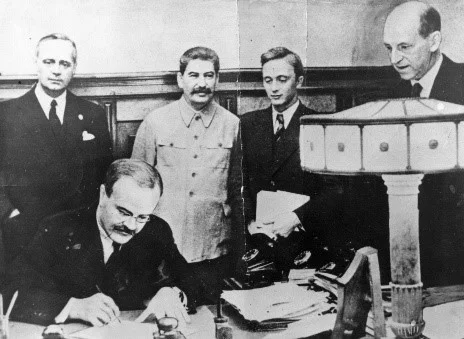
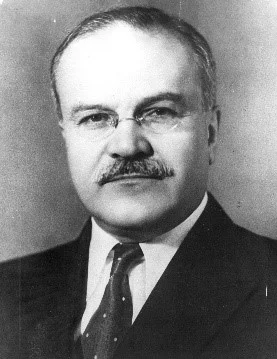
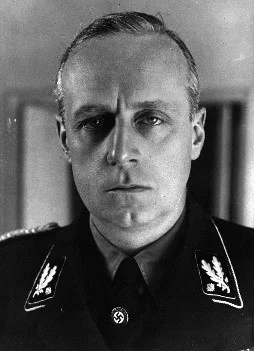
One of the most revealing contradictions of postwar justice can be found in the starkly different fates of two men who signed the same document, on the same night, reshaping Europe and unleashing catastrophe: Joachim von Ribbentrop, Foreign Minister of Nazi Germany, and Vyacheslav Molotov, Foreign Minister of the Soviet Union.
Ribbentrop was tried, convicted, and executed by hanging.
Molotov lived out his life in honor, power, and comfort.
The document they signed together—the Molotov–Ribbentrop Pact—was not merely a non-aggression agreement. It was a death sentence for millions.
The Pact That Opened the Gates of Hell
On August 23, 1939, representatives of Nazi Germany and the Soviet Union signed a treaty pledging neutrality toward one another. Publicly, it was framed as a diplomatic necessity. Privately, it included secret protocols dividing Eastern Europe into spheres of influence.
Poland would be carved in two.
The Baltic states would be absorbed.
Finland would be invaded.
Romania would be pressured.
Within days, Germany invaded Poland from the west. Weeks later, Soviet forces invaded from the east. Europe was plunged into war not by accident, but by design—enabled by diplomatic signatures wielded like weapons.
This was not passive diplomacy. It was strategic collaboration.
Ribbentrop at Nuremberg: Guilt Made Visible
At Nuremberg, Joachim von Ribbentrop was not merely charged for signing treaties. He was prosecuted for crimes against peace, war crimes, and crimes against humanity. The tribunal held that diplomacy, when used to enable aggression, mass murder, and genocide, is not morally neutral.
Ribbentrop’s role was clear:
- He facilitated alliances that enabled German expansion.
- He knowingly supported invasions in violation of international law.
- He provided diplomatic cover for atrocities across Europe.
- He remained loyal to Hitler’s war of extermination to the end.
The court rejected his defense that he was “only a diplomat.” On October 16, 1946, he was executed. Justice, at least in this instance, declared that pens could kill just as surely as guns.
Molotov’s Immunity: When Power Writes the Verdict
Vyacheslav Molotov did not stand trial.
This is not because his actions were morally distinct. He signed the same pact. He negotiated the same territorial divisions. He publicly justified Soviet invasions. He defended the deportation of entire populations from occupied territories. He remained Stalin’s loyal enforcer during purges, forced collectivization, and mass repression.
Yet Molotov emerged from the war not as a defendant, but as a victor.
Why?
Because justice after World War II was not administered by a neutral global authority. It was administered by the winners. The Soviet Union sat in judgment, not in the dock. The crimes of its enemies were prosecuted as universal evils; its own crimes were dismissed as geopolitical necessities—or ignored entirely.
The Nuremberg Trials were groundbreaking, but they were also selective.
The Moral Double Standard of “Victor’s Justice”
This asymmetry exposes an uncomfortable truth: international justice has often been constrained by power, not principle.
If Ribbentrop deserved death for enabling aggressive war, then Molotov deserved prosecution for doing the same. If secret protocols dividing sovereign nations constituted criminal conspiracy for one man, they should have done so for the other.
But the postwar order depended on Soviet cooperation. Accountability was sacrificed for stability. Moral clarity was traded for geopolitical convenience.
The result was a fractured historical memory. Nazi crimes were rightly exposed and condemned. Soviet crimes were minimized, relativized, or erased—especially in Western discourse during the Cold War, when criticism of the USSR risked political instability.
Millions of victims were left without justice, not because their suffering mattered less, but because their oppressor sat on the winning side of history.
The Cost of Silence
This selective reckoning has consequences that echo into the present.
When crimes are ignored because they are committed by powerful states, international law becomes a tool of politics rather than justice. When diplomats are shielded from accountability, atrocity gains a bureaucratic mask. When history is edited for convenience, future tyrants learn the wrong lesson: that victory absolves guilt.
Molotov’s untouched legacy is not just a Soviet issue. It is a warning. It tells us that moral outrage without consistency becomes propaganda, and that justice without universality becomes hypocrisy.
Remembering What Was Conveniently Forgotten
To acknowledge this imbalance is not to diminish the crimes of Nazi Germany. It is to insist that truth must be whole, not partial.
Ribbentrop’s execution was justified.
Molotov’s immunity was not.
The Molotov–Ribbentrop Pact stands as a chilling reminder that totalitarian systems often collaborate before they collide, and that their victims are rarely afforded the dignity of equal remembrance.
History is not merely what happened. It is what we choose to confront—and what we choose to excuse.
And when one man hangs for signing a document while another is celebrated for the same act, we are forced to ask: was justice truly served, or merely staged?
Because silence, too, can be a verdict.